How Small Brands Test Video Ads With AI Face Swap Before They Spend
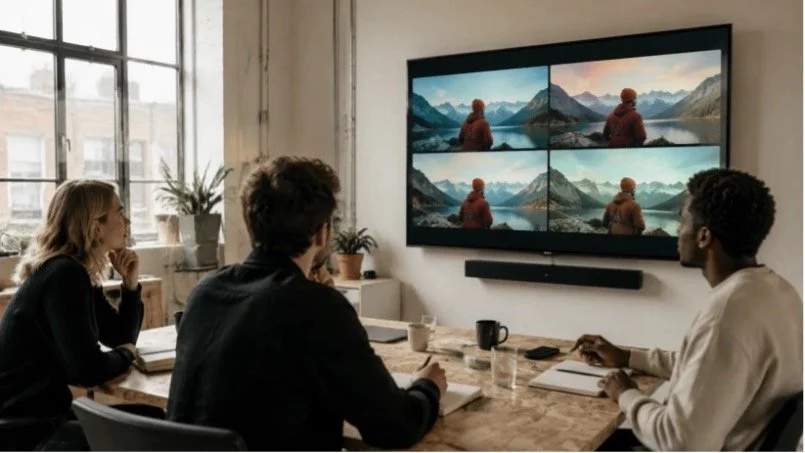
A client asks for four versions of the same thirty-second spot. Different presenter in each one, because nobody in the room can agree on who the audience will trust.
The old answer was to shoot four times, or shoot once and accept that you are guessing. Both are expensive in their own way. Four shoot days means four talent fees, four crew calls and a schedule that slips every time it rains. Guessing means you find out which presenter worked after the media budget is gone.
The number that makes this worth solving
Traditional creative pretesting runs between $5,000 and $30,000 per execution and takes one to three weeks, according to a 2026 review of testing platforms by Minds. That is per execution. Four presenters means the maths gets ugly before a single ad goes live.
Sovran's 2026 video ad benchmarks put a number on the other half of the problem: only 5 to 10% of ad creatives ever scale. Most of what you produce will be quietly switched off. You are not paying for four ads. You are paying for four ads to find the one that works, and you are paying that cost up front, before you know anything.
Shoot once, swap the presenter
The alternative that small teams have moved to is uncomfortable to describe and simple to do. Shoot the spot once with one presenter. Then produce the variants by replacing the face.
Frame-by-frame tracking is what makes this viable now. The software reads head position, angle, expression and lighting on every frame, then places the new face into the scene rather than sitting it on top. Skin tone and lighting get matched to what is already in the shot. Three years ago the result floated. It does not float any more.
iMideo, an AI tool for swapping faces in video, works by uploading one face photo and the target clip. Its ai video face swap handles footage up to five minutes long, outputs in HD 720p, and lets you choose whether to replace every face in the frame or only the male or female ones when several people are on camera. Processing takes 60 to 120 seconds depending on length and how many faces are involved, and the facial mapping runs above 95% accuracy.
The cost model is worth understanding because it changes the arithmetic. Billing runs at two credits per second of actual video, with a three-second minimum. A fifteen-second test cut is thirty credits. The Ultimate plan at $49.90 a month includes 1,100 credits, which is roughly thirty-six such clips. Commercial usage rights are included, and uploads are deleted from the servers within 24 hours.
What this actually tests, and what it does not
Teams get carried away here and produce noise instead of data.
Swapping a face tests one variable: who is delivering the message. That is a real variable, and for some categories it is the dominant one. It is not the only one, and it is often not the biggest one. Script, hook, pacing and the first two seconds usually move numbers more than casting does.
The related point is worth taking seriously: three to six genuinely different creatives will teach you more than fifty near-identical variants. Producing forty face-swapped versions of one script is exactly the trap. You will have forty ads and one idea.
There is also a floor on how cheap testing gets. You need roughly $100 to $150 of spend behind each creative before the numbers mean anything. Cutting production cost to near zero does not cut the media cost of finding out.
Use it to answer a narrow question. Does this audience respond better to a founder, a customer or a professional presenter? Four variants, one script, enough spend behind each. That is a clean test.
Where the output falls apart
The quality of the result is decided before you open any software. It is decided on the shoot.
The face photo needs to be high resolution, shot straight on, evenly lit, with the features clearly visible. Heavy filters, motion blur and low-light phone snaps produce exactly the mushy result people associate with cheap AI. The target clip wants steady camera work and a clearly visible face, and it needs to arrive as MP4 or MOV under 60MB.
Three things reliably break it. Sharp profile turns, where the face leaves frame geometry the tracker can follow. Fast motion, where there are not enough usable frames to lock onto. And scenes with several people moving across each other, where the software has to decide which face is which mid-shot.
The practical version of this: if you already know a spot will be face-swapped later, shoot for it. Keep the presenter reasonably front-on, avoid whip pans across their face, and light them properly. None of that costs anything on the day. All of it saves you a reshoot.
Teams that skip this step conclude the technology does not work. Usually the technology worked fine on unusable footage.
The permission problem
This part gets skipped, and it is the part that ends up in a legal review.
You need rights to the face you are using and rights to the footage you are putting it into. A stock video licence covers the clip. It does not give you permission to replace the performer's face, and it does not give you rights over whoever's face you are inserting. Those are separate permissions from separate people.
For internal testing this matters less, though it still matters. For anything that runs publicly it is the whole game. Get written consent from the person whose face appears, keep it, and check whether your market requires you to disclose that the content is AI-generated. Several do, and the list is getting longer rather than shorter.
Treating this as paperwork to sort out later is how a cheap test becomes an expensive problem.
Who this suits
If you produce video ads occasionally and cast one presenter because that is who you know, this changes nothing for you. Shoot the ad.
If you are running video regularly, casting is a live question and your production budget is the constraint on how much you can test, it changes the shape of the problem. The bottleneck moves from shoot days to how many clean questions you can think of.
That is a better bottleneck to have. It is still a bottleneck, and no tool fixes the part where you have to decide what is actually worth asking.