How AI Is Changing the Way We Plan and Produce Visual Content
Think about the last video you watched that actually stuck with you. Maybe it was a product demo that made something complicated feel simple. Or a short social clip that stopped your scroll. Whatever it was, somebody had to plan that thing out before a single frame got recorded.
That planning step? It's always been the slowest, messiest part of making visual content. And right now, AI is shaking it up in ways most people haven't caught on to yet.
Everyone Needs More Content Than They Can Make
This one's probably obvious if you work anywhere near marketing, training, or brand communications. The content machine never stops hungry.
One campaign might need a full length explainer for the website, a 15 second teaser for Instagram, animated graphics for an email blast, and a deck for the internal team. That's a lot of creative output. And most teams are trying to pull it off with the same processes they've been using forever.
The funny thing is, the final production part isn't usually what kills timelines. Editing software is solid. Stock libraries are massive. The real problem sits further upstream.
It's the planning. The concept. The "what does scene three actually look like?" conversations that go in circles because nobody can see what's in anyone else's head.
That's where things get stuck. And that's exactly where AI is starting to make a real dent.
Storyboarding Was Always a Pain Point
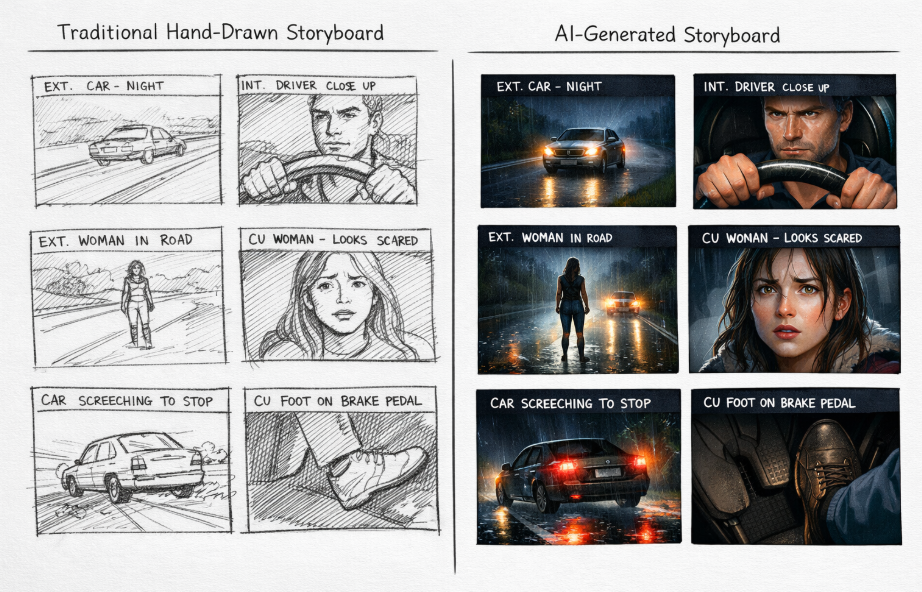
If you've ever been part of a video project, you know how storyboarding works. Someone writes a script. Then someone else (or often the same overworked someone) has to turn that script into a visual sequence, panel by panel, showing what each scene should look like.
Big studios hire dedicated storyboard artists for this. Smaller teams? They wing it. Stick figures on a whiteboard. Vague descriptions in a Google Doc. A creative director gesturing wildly on a Zoom call saying, "Picture this..."
Neither approach works great. Hiring artists is expensive. Winging it leads to miscommunication, reshoots, and wasted time.
This is why something like an AI Storyboard Generator has become such a game changer for content teams. You feed it a script or a description, and it produces a visual sequence you can actually react to. Panels. Scenes. A structure you can share with your team and say, "Okay, is this what we mean?"
It doesn't create the final product. It creates the blueprint. And having that blueprint early saves a ridiculous amount of time downstream.
It's Not Just About Working Faster
Speed matters, sure. But there's a bigger story here that gets overlooked.
For a long time, detailed pre-production planning was a luxury. If you were a scrappy startup making your first product video, a freelancer building a course, or a small nonprofit trying to produce a fundraising spot, you just couldn't afford to storyboard properly. You skipped it and hoped for the best.
AI has changed that equation. Now a two person team can approach a project with the same visual planning rigor that used to require a whole creative department. That's huge.
And the smartest teams aren't treating AI as a replacement for human creativity. They're using it as a starting point. The AI generates a rough visual framework. The humans bring the taste, the emotion, the storytelling instincts that make people actually feel something when they watch.
That combo is where the magic is.
What a Modern Creative Workflow Looks Like
The process still starts the same way it always has: with an idea. A client brief. A product launch. A training series that needs refreshing.
What's different is what happens in the next 48 hours.
Instead of a week of brainstorming sessions and email chains and "can you sketch what you mean?" conversations, a team using AI tools can move from concept to visual plan in hours. The script goes in, a visual sequence comes out, and suddenly everyone has something concrete to respond to.
This changes meetings completely. Instead of everyone squinting at a blank whiteboard trying to imagine the finished product, they're looking at actual panels. Feedback gets specific fast. "Scene four feels too rushed." "Can we swap the order of scenes two and three?" "This visual tone is off for our audience."
That kind of focused feedback used to take multiple rounds. Now it happens in one session.
When your team is remote, screen sharing makes this even smoother. You pull up the storyboard, walk through it together on a video call, and align on the vision before anyone opens an editing timeline. No more guessing what the other person pictures in their head.
The approval process tightens up too. Stakeholders are way more comfortable signing off when they can see the plan laid out visually. Ambiguity drops. Confidence goes up. Projects move.

Practical Tips If You Want to Try This
Ready to bring AI into your creative process? Here's what I'd suggest based on what's actually working for content teams right now.
Start upstream, not downstream. Most people jump straight to AI video generators or editing tools. That's fine, but the bigger wins come earlier. Use AI during storyboarding and concept visualization first. When the plan is solid, everything after it gets easier.
Treat AI output as a draft. Never ship the first thing an AI tool gives you. Think of it as a rough sketch that gives your team something to push against. The best work happens when a human creative takes that draft and shapes it with their own judgment and taste.
Explore multiple directions quickly. One of the best things about AI planning tools is speed. Instead of committing to a single concept and crossing your fingers, you can mock up three or four directions in the time it used to take to do one. That means better creative decisions.
Match tools to your actual bottleneck. A solo creator might get the most value from an AI Storyboard Generator that turns a script into visual panels in minutes. A bigger team might need something that plugs into their project management stack. Figure out where your specific slowdowns are and pick tools that solve those problems.
Don't skip the human conversations. AI can accelerate the visual side of planning, but it can't replace the strategic thinking. You still need alignment on messaging, audience, tone, and goals. Whether that happens in person or over a video conference, make sure the team is on the same page before any tool starts generating anything.

AI as a Thinking Tool, Not Just a Production Tool
Here's what I find most interesting about all of this.
For a long time, people treated the planning phase of content creation as the boring part. The "real" creative work was the final video, the polished animation, the gorgeous graphics. Pre-production was just something you slogged through to get there.
AI is flipping that. When you can visualize ideas quickly, you start to notice something: the quality of the plan basically determines the quality of the output. A clear storyboard means a better shoot. A well sequenced narrative means tighter editing. A strong visual framework means content that actually connects.
So AI isn't just making pre-production faster. It's making people take it more seriously. And that's raising the quality bar across the board.
Looking Ahead
The teams pulling ahead in visual content right now aren't necessarily the ones with the biggest budgets. They're the ones who've figured out how to think better during the planning phase.
These tools are still evolving. What's possible today is just the starting line. But the teams that start building AI into their workflows now, learning what works, figuring out where it fits, will be way ahead as the demand for visual content keeps climbing.
The goal was never to automate creativity. It's to amplify it. Give your team back the hours they used to burn on manual planning so they can spend that time on what actually matters: understanding the audience, crafting the story, making creative choices that turn information into something people want to watch.
The future of visual storytelling isn't human versus machine. It's a human plus machine. And the teams that figure out that partnership first are going to be the ones producing the content everyone else wishes they'd made.