8 Top Sustainable Packaging Companies for the Manufacturing Sector (2026)

Sustainable packaging is now a KPI. Boards want proof, and procurement must pick greener options that scale without eroding margin. The market is listening: valued at $271.9 billion in 2023, it is on track for $393 billion by 2028—a 7.7 percent CAGR.
Most “top supplier” lists still recycle 2021 favorites and skip the math. We built a new one. Inside, you’ll meet eight providers backed by current data, verified certifications, and case studies that translate into lower emissions, leaner logistics, and real savings. Let’s unpack them.
How we built the list
Before we named any winners, we wanted proof: hard numbers, recent data, and real manufacturing case studies. So, like any grounded sourcing team, we audited the market.
First, we reviewed more than fifteen “top sustainable packaging” round-ups published between 2021 and 2026. Most were big on buzzwords yet thin on metrics. They seldom addressed cost, compliance, or scale, the levers you and I deal with every day.
Next, we drafted a global longlist of twenty-five suppliers that actively serve industrial clients. The mix spanned paper giants, flexible-film specialists, and biotech newcomers such as corrugated titans, mushroom-foam innovators, and everyone in between.
Then came the scorecard. We weighted seven factors that directly affect a factory floor or a supply-chain spreadsheet:
Sustainability credentials – 25 percent
Manufacturing scalability – 20 percent
Material innovation – 15 percent
Cost competitiveness – 15 percent
Geographic reach and logistics support – 10 percent
Client proof and case studies – 10 percent
Compliance certifications – 5 percent
Each company’s latest ESG report, patent filing, or customer testimonial fed into that matrix. When scores tied, we chose the supplier with fresher innovations or more manufacturing-sector wins.
Finally, we cut the list to eight standouts. Some household names didn’t make the grade, and a few smaller players punched above their weight. The result is a ranking that balances scale with ingenuity, giving you options whether you need billions of boxes or a breakthrough material for a niche line.
That’s the playbook: clear criteria, transparent weighting, and no paid placements, so you can trust the order that follows.
Macro trends shaping the 2026 market
1. Regulatory pressure is now a daily line item

Legislators once cheered from the sidelines; now they write rules that decide which materials may reach your loading dock and how much waste you can leave at the curb. Seven United States states already run extended-producer-responsibility programs that push disposal costs back onto brand owners. Europe is moving faster, finalizing a Packaging and Packaging Waste Regulation that requires every pack to be recyclable or reusable by 2030.
The impact is more than paperwork. PFAS bans have forced food-service suppliers to pull entire product lines. Substance lists grow each quarter, and fines arrive faster than infrastructure updates. Partner with suppliers who prove compliance across regions, or budget for penalties and relabeling. Top-ranked companies in our list track chemical footprints to parts per million, keep on-site auditors, and fund local recycling programs so you stay on the right side of the law while competitors scramble.
2. Customers are voting with contracts and wallets
Surveys show that eight in ten buyers will pay a premium for responsibly wrapped products. Those preferences move up the value chain quickly. Multinationals now bake packaging targets into supplier scorecards, right beside quality and cost.
Tier-1 and Tier-2 manufacturers feel the squeeze: brand owners want proof of recycled content, carbon savings, and recyclability rates before signing a contract. The suppliers we rank highest treat those demands as design inputs, publishing annual progress and inviting third-party audits so you can hand metrics to clients without last-minute data hunts.
3. Material breakthroughs are moving from lab to loading dock
Five years ago, mycelium foam and seaweed film sounded like science-fair projects; today they ship by the container load. Continuous R & D plus serious capital have pushed bio-based and ultra-light materials out of pilot rooms and onto industrial packing lines.
Paper is getting a tech upgrade too. Tetra Pak’s new carton swaps its aluminium layer for a paper barrier, lifting fibre content to about eighty percent and earning Carbon Trust carbon-neutral status. Flexible films follow: mono-PE laminates and high-PCR blends from suppliers such as Amcor seal snack bags while entering existing recycling streams. The top eight suppliers either patent novel substrates, invest in dedicated bio-material plants, or secure exclusive rights through start-ups, giving you first-mover access without betting the factory on an unproven material.
4. Reuse and true circularity are finally practical
The question has shifted from “Is it recyclable?” to “How many trips can the same asset make?” Closed-loop models once limited to pallets now scale into crates, drums, and even consumer-facing refill programs.
Automotive suppliers ship engine parts in rugged plastic totes that cycle through plants for years. Electronics makers adopt paper-based systems that fold flat for return, cutting waste and inbound freight. Cosmetics and detergent brands join refill stations and return-from-home schemes that keep primary packs in circulation. Better reverse-logistics tech, RFID tracking, and partners who design durability from day one make this possible. The leaders on our list offer take-back agreements, remanufacturing lines, or in-house recycling mills, so you can book a measurable waste reduction today.
5. Automation levels up efficiency and sustainability in one stroke
Robots and algorithms are rewriting packaging rules. On many shop floors, camera-guided cutters create right-sized boxes on demand, removing excess fibre and the void fill that once padded the gap. Upstream, engineers run digital twins of entire supply chains, testing lighter formats virtually before the first prototype leaves a die cutter.
These tools do more than save labour. They let you prove, to the decimal, how many kilograms of material and carbon each redesign avoids. Suppliers in our top eight sell the machinery or integrate with your existing line, turning sustainability gains into quantifiable cost savings. In short, smarter lines mean leaner footprints.
A quick-glance toolkit for busy buyers
Charts and tables beat paragraph math when you are skimming between production meetings. We have prepared three visuals that let you size up each supplier in seconds.
First comes a criteria-weighting table that shows exactly how the seven factors flow into the final score. No mystery, only transparent math you can replicate in your own vendor reviews.

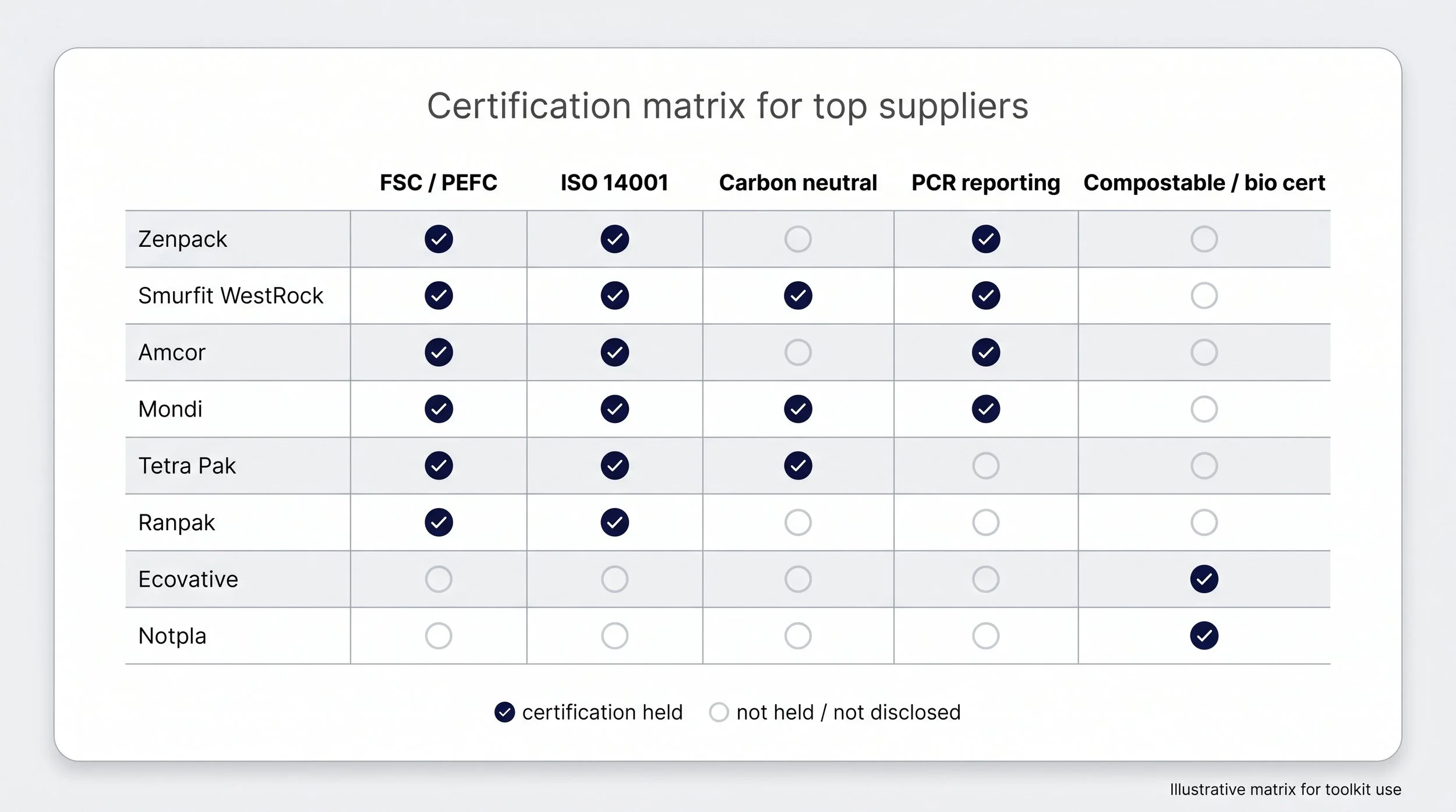
Next, we line up the eight companies in a certification matrix. One row per supplier, key standards across the top. A quick scan reveals who holds FSC or ISO 14001, who claims Carbon Neutral status, and who still has gaps to close.
Last, we plot cost against innovation in a simple quadrant. You will see at once whether a disruptive newcomer justifies a price premium or if a long-time player now excels at both scale and R & D.

Keep these visuals handy. They turn a twenty-minute read into a two-minute reference when senior leadership asks, “Who should we call first?”
1. Zenpack: custom design meets rigorous sustainability
Zenpack is the agile partner you call when off-the-shelf will not cut it. The team specializes in custom packaging boxes that blend award-winning design with cradle-to-curb sustainability thinking.
The company’s strength is end-to-end service. In-house teams sketch, prototype, and manufacture at industrial scale, so you move from concept to ship-ready SKU without juggling multiple vendors. That single thread cuts approval loops and keeps brand intent intact.
On the material front, Zenpack leans hard into fiber solutions such as FSC-certified corrugated, molded pulp, and paper-based child-resistant formats like the ZenLock series. Plastics appear only where performance demands it, and even then the firm looks for bio-based or high-PCR options.
Credibility matters, so they put third-party proof on the table. The Butterfly Mark from Positive Luxury recognizes their social and environmental governance, while recent FSC Chain of Custody credentials let you print that green label on every carton. For procurement teams scored on compliance, those stamps shorten the internal debate.
Cost often decides the final agreement. Zenpack tackles it with right-size engineering and structural ideas that trim material weight and freight volume. Their right-sized cartons pass Amazon’s ISTA 6 “Ships in Product Packaging” drop test, which can save up to $0.23 in fulfillment fees per unit on packages between three and twenty pounds.
The trade-off? As a fast-growing mid-sizer, Zenpack lacks the continental plant network of billion-dollar rivals. Large global rollouts may involve longer lead times or dual sourcing. Still, for high-value goods that need bespoke packaging and a strong sustainability story, Zenpack offers a blend of creativity, compliance, and measurable ROI that larger incumbents rarely match.
2. Smurfit WestRock: fiber titans join forces for circular scale
When Smurfit Kappa and WestRock signed their 2024 merger, they did more than form a larger company; they combined the world’s widest corrugated footprint with a closed-loop recycling engine that already collects millions of used boxes each week.
Scale is their strength. With more than 300 plants across over thirty countries, Smurfit WestRock can replenish line-side inventories wherever your factory runs, then send the spent fiber back to its own mills for a second life. That loop underpins a headline metric: a 43.9 percent drop in carbon emissions since 2005, verified in the group’s latest sustainability report.
Innovation continues under the new banner. Engineers introduced water-resistant paper wraps that replace shrink film, honeycomb cushions strong enough for white-goods shipping, and design software that proves material savings before a die is cut. Ninety-four percent of shipments already carry FSC or PEFC chain-of-custody certificates, turning compliance paperwork into a formality.
Cost stays competitive because fiber is their home turf. Add take-back rebates for recovered corrugate and you often beat plastic on total landed cost. For manufacturers seeking global consistency and measurable carbon gains, Smurfit WestRock meets at the crossroads of volume and verified circularity.
3. Amcor: multi-material mastery with ambitious recyclability targets
Amcor brings a different strength to the table: material versatility. From mono-PE snack pouches to medical-grade rigid containers, the company supplies nearly every format you might need, then backs each one with a plan for full circularity.
Years ago, Amcor pledged that every product would be recyclable, reusable, or compostable by 2025. The latest sustainability report shows that 72 percent of packaging by weight now meets that bar, with 233,000 tonnes of post-consumer resin already running through its lines. That progress matters in regions where recycled-content minimums are no longer optional.
R & D budgets exceed 100 million dollars a year. Flagship launches include AmPrima PE Plus, a mono-material laminate that moves straight into existing polyethylene recycling streams, and AmSky, the first PVC-free blister pack cleared for mainstream pharmaceutical use. Each release targets a high-volume pain point, letting customers switch without retooling filling lines.
Footprint helps too. More than 220 plants across over forty countries keep lead times short and logistics costs predictable. During pandemic-era resin shortages, the network shifted capacity to keep customers stocked while rivals rationed supply.
Pricing sits in the middle, but Amcor often closes deals by quantifying savings from downgauged films and lighter closures. When a chocolate maker replaced a foil laminate with an AmPrima pouch, carbon fell 53 percent and shipping weight dropped enough to offset the film’s slight price premium.
If your catalogue spans liquids, powders, and sterile devices, Amcor provides a one-stop path to harmonized, recycle-ready packaging supported by the R & D muscle to keep pace with the next wave of regulations.
4. Mondi: paper-first solutions that keep performance intact
Mondi’s mantra is simple: use paper wherever possible and plastic only when it adds clear value. That philosophy has pushed the London-listed group to the leading edge of fiber advances, from heavy-duty industrial sacks to high-barrier paper pouches that resist grease and moisture.
Operations span more than thirty countries, yet the model stays vertically integrated. Mondi owns the forests, the pulp mills, the converting plants, and, increasingly, the recycling capacity. That control lets the team dial in quality while shielding customers from wild spot-market swings on fiber or resin.
On the product side, two launches stand out. Advantage StretchWrap replaces pallet stretch film with a reinforced kraft that stretches around loads and recycles like any other cardboard. PerFORMing trays swap EPS meat packs for pressed paper with a micro-thin barrier, cutting plastic up to eighty percent without sacrificing shelf life.
Sustainability metrics back the claims. The firm reports a forty-eight percent reduction in Scope 1 and 2 greenhouse-gas emissions compared with its 2019 baseline, exceeding its near-term goal of 46.2 percent by 2030 on the way to net-zero mid-century. About eighty percent of the portfolio is already recyclable, compostable, or both, and every ton of paper ships with FSC or PEFC credentials.
Costs often surprise newcomers. Because Mondi controls the fiber loop, many paper replacements land close to parity with legacy plastic once you factor in disposal fees and rising plastic taxes. Add European proximity for EU manufacturers, and lead times shrink alongside emissions.
If you need to shift from film to paper without re-engineering entire lines, Mondi offers plug-and-play options that satisfy compliance teams and keep performance KPIs intact.
5. Tetra Pak: aseptic cartons edge closer to all paper
If your production line fills liquids, you already know Tetra Pak. The company’s carton-plus-filling-machine system has long set the standard for shelf-stable milk, juice, and soups. The recent shift lies in the material science inside each pack.
In 2023 Tetra Pak piloted a carton that replaces most of its aluminum barrier with a paper layer, raising fiber content to roughly eighty percent while earning Carbon Trust carbon-neutral status. Less metal means simpler recycling, lower carbon, and a smoother path through new European rules that discourage composite laminates.
Recyclability is not just talk. Carton Council data show household access to carton recycling in the United States now tops sixty percent, thanks in part to grants and equipment Tetra Pak funded. The company also co-invests in pulping lines worldwide, giving brands a credible end-of-life story to share with regulators and consumers.
On the equipment side, recent fillers cut energy use up to thirty percent versus earlier models, and tethered caps introduced in 2024 help customers comply with upcoming European litter legislation without retooling cappers.
Cost often undercuts glass and HDPE once you factor in ambient shipping and lighter weight. For manufacturers aiming to trim cold-chain energy and packaging footprints in one move, Tetra Pak’s evolving carton range delivers a quick win backed by a partner committed to continuous improvement.
6. Ranpak: paper-powered protection for e-commerce and industry
Void fill and cushioning rarely make headlines, yet they consume a surprising slice of packaging budgets. Ranpak built its business on replacing plastic pillows and foam peanuts with curbside-recyclable paper that converts on demand at the packing bench.
The hardware is half the appeal. Operators feed kraft rolls into tabletop machines that turn out crumpled pads or honeycomb wrap in real time. No bulky storage, no prefilled airbags, and—most important—no fossil-based plastic headed to landfills. Installations scale from a single station in a repair shop to fully automated lines that pack 1,200 boxes an hour for global e-commerce brands.
Sustainability lives in the raw material. Ranpak’s paper averages 66 percent recycled content and carries FSC or PEFC certification. Because the pads trap ambient air instead of inflated LDPE, life-cycle analyses show up to 50 percent lower carbon for the same protection level.
Cost savings often begin with freight. Kraft rolls cube efficiently, so inbound truck counts drop. Faster pack times and fewer damage claims follow; honeycomb wrap grips glass and ceramics better than bubble. Many users see double-digit reductions in total packed-product cost.
Weight is a common concern. Paper does weigh more per unit, but right-sizing software integrated into Ranpak’s systems often shrinks box dimensions enough to offset the extra grams. When plastic taxes arrive, the financial case tilts further toward paper.
For manufacturers shipping high-mix, high-care items—from circuit boards to spare parts—Ranpak offers a quick, equipment-light route to cut plastic, speed fulfillment, and score sustainability points at the same time.
7. Ecovative: mushroom packaging that replaces foam, not margins

Ecovative mycelium-based mushroom packaging replacing foam corner blocks
Styrofoam corner blocks have crowded loading docks for decades. Ecovative offers an alternative by growing protective inserts from mycelium (the root structure of mushrooms) blended with agricultural waste. Place the mix in a mold, wait a few days, dry the result, and you get a custom cushion that matches EPS on drop tests yet composts in a backyard heap.
The environmental upside is clear: zero petrochemicals, minimal energy input, and full biodegradation within weeks. Throughput and cost matter too, and scale has improved quickly. A new 120,000-square-foot facility in New York can produce three million pounds of mycelium each year, while licensed partners in Europe and Asia shorten lead times and trim freight emissions.
Early adopters prove the concept. Dell swapped EPS for mycelium blocks in server packaging and kept damage rates flat while reducing landfill waste. Furniture maker Steelcase ran similar trials on table corners with the same success. These case studies give procurement teams confidence that performance claims are real.
Cost has narrowed to within ten to fifteen percent of commodity foam at mid-volume runs, and upcoming bans on EPS tilt the equation further. For brands that sell sustainability as a core value, the marketing lift often justifies the slight premium.
Limitations remain. Mycelium parts suit rigid shapes better than flexible voids, and lead times are measured in days, not hours. Yet as bans expand and production ramps, mycelium cushions appear less like a curiosity and more like the next default for fragile, high-value goods.
8. Notpla: seaweed films solve the sachet problem at its root
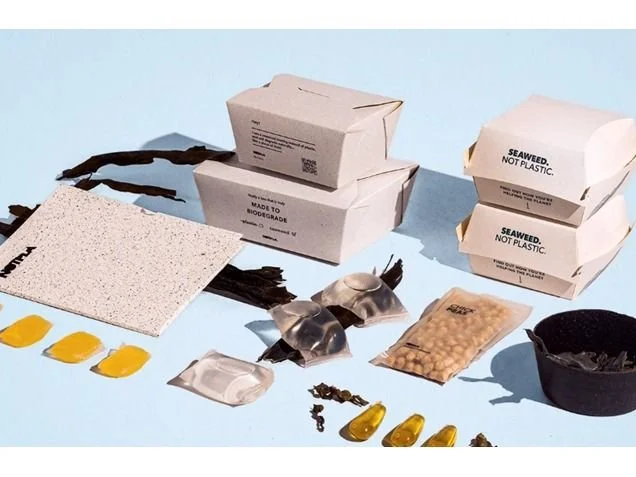
Notpla seaweed-based sachets and Ooho edible water capsules
Single-use sachets are the weak link in many sustainability plans. They slip through recycling nets and litter beaches worldwide. London-based Notpla addresses that issue with films and coatings made from fast-growing brown seaweed; no fossil feedstocks, no microplastics, and full biodegradation within four to six weeks.
The Ooho capsule, Notpla’s headline product, drew crowds at the 2019 London Marathon when runners bit into edible water bubbles instead of tossing plastic cups. Since then, production has grown from novelty to industrial. Just Eat Takeaway has shipped about four million seaweed-lined packaging units since 2022, proving the coating runs on standard paperboard lines and survives hot curry or greasy fries.
For manufacturers, the advantage lies in drop-in compatibility. Notpla’s coating fits existing cup and tray production without exotic curing steps, cutting plastic liners by up to 100 percent. Early pilots with condiment sachets show similar ease: change the reel stock, keep the same form-fill-seal machine.
Seaweed supply is scaling quickly through European and South American aquaculture partners, so price now matches PLA and other biopolymers. Future plastic taxes are likely to widen that gap. Certifications such as TÜV OK Compost Home give regulators and consumers the proof they expect.
Limitations are mostly barrier related: the film suits dry or short-shelf-life wet goods better than oxygen-sensitive items. Yet for takeaway, cosmetics samples, and small-format dry blends, Notpla offers a low-friction route to remove one of the most stubborn forms of plastic waste.
Conclusion
These eight suppliers demonstrate that sustainability and performance no longer sit at opposite ends of the packaging spectrum.
Manufacturers handling perishable products can also benefit from chamber vacuum sealer bags, which improve product protection, extend shelf life, and support efficient, sustainable packaging operations across industries.
Whether you need global scale, breakthrough materials, or equipment-ready solutions, the options outlined here provide a roadmap to lower emissions, leaner logistics, and resilient supply chains in 2026 and beyond.