

Every business that runs ads online has the same problem sooner or later. Ads on Facebook and Google cost more every year. The same campaign that worked two years ago now needs more money to get the same result. So people start asking if there is anywhere else to try.
For a lot of them, the answer is native advertising platforms. And the first surprise is how big they are. You know the row of headlines with small pictures at the bottom of a news article? Those are native ads. They reach billions of people every month on most of the big news websites in the world. But most people cannot name even one company behind it.
This article looks at the native advertising platforms that are actually worth your time in 2026. It covers what each one is good at, what to check before you spend money, and why one platform that most people have never heard of is at the top of the list.
What makes native advertising platforms different from each other
At first they all look the same. A box under an article. Some headlines. Some pictures. You pay when someone clicks. The real differences are hidden, and they decide whether the platform works for you or not.
How many people they can reach.
The big networks run on thousands of websites and say they reach billions of people a month. But reach matters less than it sounds. Very few businesses need all of it. What matters is whether the platform reaches the kind of reader who wants your product, at a price you can pay.
How they pick who sees your ad.
This is the biggest hidden difference. Native networks do not know people the way Facebook does. They cannot target by age or hobbies. What they can use is the page the reader is on, what that reader has clicked before, and any data the platform gets from its parent company. A platform with better data finds buyers with less waste.
What websites they run on.
Every network has good websites and bad websites. All of them let you block the bad ones. But you have to do it yourself, and some platforms make it easier than others.
How they check new advertisers.
Native platforms look at your landing page, not just your ad. Getting rejected with no reason given is very common when you start. Some networks check faster. Some are stricter. Some will tell you what went wrong and some will not.
How much real traffic they have.
The reach number is what the platform claims. A better measure is how many advertisers are running ads on it right now. That tells you how much demand there is and how crowded the auction is.
The attention gap
Before the list, one chart that shows why it is in this order.
Data from Ahrefs for September 2026 shows that Taboola gets about 11,000 Google searches a month in the United States. Outbrain gets about 2,400. MediaGo gets about 150. Now look at what each one says it reaches. Taboola says 1.4 billion people a month. Teads, which now owns Outbrain, says 2.2 billion. MediaGo says more than 1 billion.
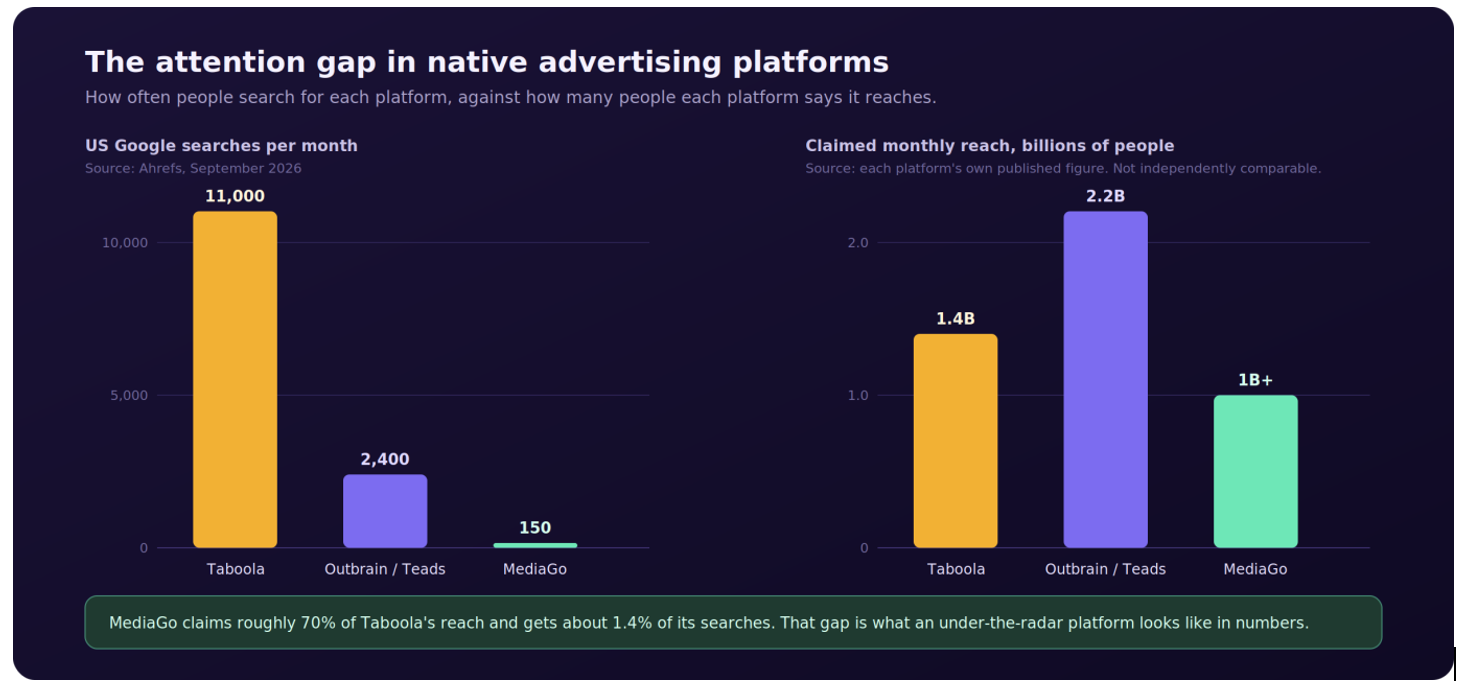
So MediaGo says it reaches about 70 percent as many people as Taboola. But it gets only about 1 percent as many searches. Almost nobody is looking for it. In advertising, a platform with real size and no attention is where the auctions are least crowded. This is why it is first on the list.
1. MediaGo
MediaGo is the international ad platform of Baidu, the biggest search company in China. It has been running since 2018 under the Baidu Global name. It calls itself an AI marketing platform, and it says it works with more than 10,000 advertisers and reaches more than 1 billion internet users a month across North America, Europe, the Middle East, East Asia and Southeast Asia.
Its websites are not small ones. Since 2022 it has bought ad space through Xandr, which is Microsoft's ad marketplace. That gives it good native and display spots in the United States, with more added in Europe, Asia and Latin America. In January 2024 it joined Amazon Publisher Services too, which opened up another group of big publishers. Independent ad trackers have seen MediaGo ads running on MSN and other large portals. These are the same kind of websites the bigger networks fight over.
The thing that makes MediaGo different is where its targeting data comes from. The big native networks learn from what people do inside their own ad boxes. MediaGo sits inside a company whose main business is search. It says it does precision marketing for a world with less tracking. It uses the page the reader is on and Baidu's machine learning to guess who is likely to buy, without following people around the internet. For advertisers in Europe, where privacy laws make tracking hard, that matters. It won an AI industry award for this in 2024.
Two things to be careful about. Both come from outside data, not from the platform itself.
First, MediaGo's group of advertisers is small and changes fast. OpenAdLibrary, a tool that tracks live native ads across 50 networks, counted about 7,000 MediaGo ads in July 2026, with about 800 live in the last 30 days. So about 11 percent were live, the lowest of the big networks. You can read that two ways. It is a thin market. Or it is an auction with far fewer bidders than Taboola, where the same money buys more.
Second, a lot of its advertisers have been ecommerce sellers based in China selling overseas, and the platform is aimed at ecommerce first. If your product has a story and you have a page that tells it, it works well. If you sell something people already understand and just need to buy, it works less well. This is true of every platform on the list.
MediaGo also checks landing pages strictly, and it works with GeoEdge and The Media Trust to block bad ads. So the network is policed. Expect your website to be checked before anything runs.
Best for: advertisers already running native ads who want a second source with less competition. Ecommerce and content advertisers who send people to an article first. And anyone whose European campaigns got squeezed by privacy rules.
2. Taboola
Taboola is the biggest of all the native advertising platforms and has been for about ten years. It reaches about 1.4 billion people a month across about 9,000 websites. It has exclusive deals with NBC News, the USA Today network and Microsoft's MSN, and it added Fox News in the second quarter of 2026.
In 2025 it rebuilt its ad platform and named it Realize. It has four ways to bid, from manual cost per click to full automation. Taboola's own advice is that the automatic modes need a daily budget of 10 to 15 times your target cost per sale before they have enough data to work. Most new advertisers never hear that number. Taboola also added Taboola Select, which is its top 15 percent of US websites, and DeeperDive, an AI that answers reader questions on news sites. Ads show inside those AI answers, and Taboola's CEO says they convert better than anything else the company runs.
Money wise, it is the healthiest company on this list. In the second quarter of 2026 it made $476.8 million in revenue and a net profit. It raised its forecast for the year and it has been buying back its own shares. Its stock still dropped almost 30 percent on results day because revenue was lower than analysts expected. But the business itself is solid.
Best for: advertisers who want sales, anyone who needs big reach, and campaigns that need tight control over which websites the ads run on.
3. Teads, which used to be Outbrain
Outbrain bought a French video ad company called Teads for about $900 million in February 2025. By June it had renamed the whole business Teads. The ad boxes on news websites still mostly say Outbrain, and the auction underneath did not change. What the deal added was video ads and ads on connected TVs.
The combined company says it reaches 2.2 billion people a month and works directly with more than 10,000 publishers in 36 countries. Its websites lean toward the premium end. Its review process is slower and more manual than Taboola's, but it talks to you more once your account has spending history.
The money side is the warning. In the second quarter of 2026 its revenue fell 17 percent. Its adjusted earnings fell 74 percent. It lost $42.5 million and it pulled its forecast for the whole year. It said the weak parts were direct response and small business advertisers, which is exactly the group most performance advertisers belong to. It owes about $614 million and has about $91 million in cash. Connected TV grew 67 percent and that is where it is now putting its money.
Best for: brand advertisers, anyone with a video, and campaigns where the client will ask exactly which sites the ads ran on. If you are a performance advertiser, expect more changes.
4. Microsoft Audience Network
Most advertisers do not think of Microsoft as one of the native advertising platforms. But its Audience Network puts native ads on MSN, Outlook.com, the Edge browser and partner sites. It reaches a big audience that leans older and uses desktop computers.
The warning here is well known. If you run search ads on Bing, they show on the Audience Network automatically. A lot of advertisers find out later that a big chunk of their search budget went to display ads they never asked for. The ads are real and they work for some kinds of business. But it is a network most people end up on before they choose it. Run it on purpose with your website blocks set first, or turn it off.
Best for: advertisers who actually want the MSN and Outlook audience.
5. MGID
MGID is a big native network that is strongest in Europe, Latin America and Southeast Asia. Its clicks are cheaper than the big two, and most advertisers say the traffic needs more filtering to get the same quality. It is usually the third platform people test, once they have a setup that works and want more volume at a lower price.
Best for: advertisers with a working native setup who want to grow in cheaper markets.
How to test any of them without wasting money
The platforms are different. The way to test them is the same. And most native tests fail for the same few reasons.
Send the click to an article, not a product page. The native reader was not looking for you. They were reading something else and a headline caught their eye. If they land on a price and a buy button, most of them leave. What works is a long article, a list, or a comparison page that keeps the story going and makes the case before the offer shows up.
Give it enough budget to learn. Fifty dollars a day shows you a signal. A few hundred dollars a day per campaign is the real minimum in the United States. One to two hundred works in a mid-size European country. Run for 10 to 14 days before you decide anything. And send soft conversions like add to cart and time on page back to the platform so it has enough data to learn from.
Set your website rules before you launch. Every platform here lets you block websites. The better ones let you set rules that block a site automatically when its click rate is high and its sales rate is low. Do this on day one and you never pay for the worst sites.
Read your results in a tool that tracks the whole customer journey, not just in the platform dashboard. Native ads often start a sale that a Google search or a retargeting ad finishes. The native dashboard does not see that sale. A lot of advertisers turn off native because the dashboard showed nothing, when it was actually working.
Getting onto the platforms
Every native ad platform checks new advertisers and every landing page before anything runs. MediaGo in particular checks the destination URL right at the start. Approvals can take days. Rejections often come with no reason. A business that has never run native ads before can lose two weeks just getting through the door.
This is why a lot of advertisers, especially ones running on more than one network, go through an account provider like AdScaleLab instead of opening a self-serve account on each platform one by one. The provider already has the relationships. The URL check happens before any money moves. And one login covers several networks. It is the same reason a small importer uses a customs broker instead of learning all the paperwork.
Whichever way you go, get four answers in writing before you pay anything. When is my URL checked, before or after I pay? What happens to money I do not spend? What happens if my account gets suspended? And what am I not allowed to run?
The short version
The native advertising platforms worth your time in 2026 are a shorter list than the marketing makes it look. Taboola is the default choice for size and it is the healthiest company. Teads is the choice for brand and video, but it is having a hard year. Microsoft's network is worth running on purpose or turning off. MGID is for volume once your setup works.
And MediaGo is the one almost nobody has tested. It is backed by a company with a search business. It gets its ad space from the Xandr and Amazon marketplaces. Its targeting is built for a world with less tracking. And its auction has a fraction of the competition. The attention gap in the chart above is not a weakness. For an advertiser, it is the opportunity.
