
Migrating off Legacy Hospitality Software Without Breaking Operations or the Budget

Legacy hospitality software has a way of feeling free. The license was paid off years ago, the staff know the screens, and the system mostly works. But at some point, maintenance fees climb, integrations need constant patching, and peak-season slowdowns quietly cost direct bookings. This is where hospitality software development services become a financial conversation rather than a technical one. When done well, a migration protects operations and reduces the total cost of ownership at once. But what does a good migration actually mean in practice? Let’s figure it out together!
The Real Cost of Staying on Legacy Hospitality Software
Most of the spend never lands on a single invoice. It scatters across IT, operations, front desk, and revenue management. Renewal fees creep up. Integration patches get billed by the hour. Manual reconciliation between disconnected systems quietly absorbs staff time that should go to guests, and onboarding new hires onto an outdated interface adds weeks to every turnover cycle.
This kind of fragmentation is why the numbers look smaller than they actually are. When finance reviews the PMS line item in isolation, it looks reasonable. The full picture only appears once someone adds up what each department is absorbing on its own. Operators routinely underestimate that total by 40 to 60 percent, which is exactly why the business case for migration often looks weaker on paper than it deserves to.
Why Legacy Systems Rarely Trigger Urgency Until It's Too Late
Legacy hospitality platforms almost never fail in a dramatic way. They slowly degrade instead. The deterioration is slow enough that operations teams adapt around it, and by the time the cost becomes visible at the executive level, the system has already pulled margin out of the business for years. Here is what that quiet erosion usually looks like:
Reports run slower each quarter. A night audit that once took 20 minutes now takes an hour. Revenue managers wait longer for the data they need to price the next day, so decisions get made on stale numbers.
Integrations drift out of sync. APIs change on the OTA side, the channel manager lags, and rate parity issues start appearing. Each one is small. Together, they cost bookings every week.
Vendor support shrinks. Tickets take longer to resolve. Engineers familiar with the old codebase retire or move on. Patches arrive late, and security updates eventually stop altogether.
Workarounds become institutional knowledge. Staff learn which screens to avoid, which reports to export manually, and which steps to repeat because the system loses data. That knowledge walks out the door with every resignation.
New features become impossible to add. Mobile check-in, dynamic pricing, and guest messaging require modern APIs the legacy system cannot expose, so the property falls behind competitors that can ship updates monthly.
Building the Business Case Finance Will Actually Approve
Migration projects stall when they reach the CFO's desk as IT spend. The same project gets approved when it arrives as a cost-reduction initiative with a defined payback window. The reframing is not cosmetic. A proper business case compares total cost of ownership across a 3 to 5 year horizon, includes the hidden operational costs covered earlier, and ties the investment to KPIs finance already tracks. Payback timelines vary by group size, but the structure of the argument stays the same.
| Group size | Typical TCO horizon | Realistic payback | KPIs that justify the spend |
|---|---|---|---|
| Single property or boutique (1 to 5 hotels) | 3 years | 14 to 20 months | Direct booking conversion rate, night audit time, integration support hours, and staff onboarding time |
| Mid-sized group (6 to 25 hotels) | 4 years | 18 to 28 months | RevPAR by property, channel manager error rate, IT ticket volume, reconciliation hours per month |
| Large group or chain (25+ hotels) | 5 years | 24 to 36 months | Group-level revenue leakage, OTA commission ratio, system uptime during peak, time to launch new properties |
The numbers that matter to finance are not the license savings. They are the recovered staff hours, the direct bookings that stop leaking to OTAs, and the new property launches that no longer take six months of custom integration work. Framed this way, migration stops competing with marketing or capex for budget. It starts paying for them.
The Phased Migration Playbook that Protects Operations
A migration that protects daily operations follows a predictable sequence. The order matters as much as the technology choice, because every step in well-planned hospitality IT solutions either reduces risk or creates it.
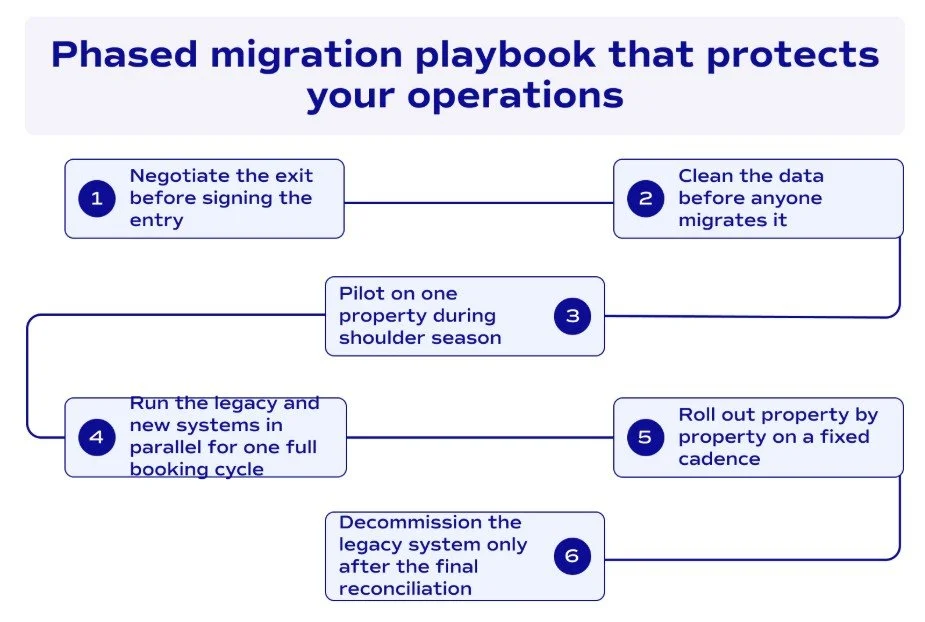
Negotiate the exit before signing the entry. Lock in data export rights, transition support hours, and a fixed-fee extension window with the legacy vendor before procurement of the new system begins. Hostage pricing during migration is the single most common budget killer.
Clean the data before anyone migrates it. Deduplicate guest profiles, reconcile loyalty records, archive transactions older than the retention policy requires, and standardize property codes across systems. Dirty data carried into a new platform produces dirty reports for years.
Pilot on one property during shoulder season. Choose a property with average complexity, not the easiest one. Shoulder season gives staff bandwidth to learn the new system and gives engineers time to fix what the pilot exposes before peak occupancy arrives.
Run the legacy and new systems in parallel for one full booking cycle. Reservations, check-ins, night audits, and month-end reporting all need to be verified against the old system before cutover. Parallel running adds cost, but it is the cheapest insurance available.
Roll out property by property on a fixed cadence. Group properties by similarity of operations rather than geography. Each rollout should incorporate lessons from the previous one, with a documented playbook updated after every wave.
Decommission the legacy system only after the final reconciliation. Keep read-only access to historical data for audit and reporting purposes, and verify that every integration on the new platform has been live through a full peak season before shutting the old system down.
Where Migration Budgets Quietly Blow up
Most migration projects don't fail on the headline price. They fail on the line items nobody costed properly during procurement. Here are the categories that consistently consume the contingency budget before the rollout reaches its second property.
Underestimated data cleanup. Procurement teams assume the legacy system holds clean records; engineers discover duplicates, orphaned reservations, and inconsistent property codes that take weeks to reconcile.
Custom integrations across the stack. Connecting the new platform to PMS, POS, channel manager, CRM, and loyalty systems rarely uses off-the-shelf connectors, so each integration becomes a small engineering project of its own.
Scope creep from individual property managers. Every general manager wants one custom report or workflow tweak, and approving them case by case turns a defined migration into an open-ended development contract.
Training costs that scale with turnover. Hospitality has high staff churn, so the training budget gets spent once at launch and then again every few months as new hires cycle through every property.
Parallel-run overhead. Running both systems through a full booking cycle protects operations, but it doubles licensing, support, and reconciliation effort during the overlap window.
Post-go-live stabilization work. The first 90 days surface edge cases that procurement never modeled, and the engineering hours to fix them are almost always billed outside the original statement of work.
What Success Looks Like 12 Months In
A successful migration shows up in the numbers, not the announcement. By month twelve, the new platform should be carrying every booking cycle without parallel support, and the operational KPIs from the original business case should be moving in the right direction. Direct booking conversion climbs, night audit time drops, channel manager errors fall, and reconciliation hours shrink to a fraction of the legacy baseline. Cash flow in the first year is rarely net positive because of training and stabilization spend, but the trajectory is clear enough for finance to greenlight the next phase.
That next phase is where custom development starts paying compounding returns. With a clean foundation in place, automation can extend across revenue management, housekeeping, and guest communication. Analytics finally run on consistent data, so forecasting becomes a tool rather than a guessing game. Guest-facing features that were impossible on the legacy stack, mobile check-in, in-app messaging, personalized offers, become realistic projects measured in weeks. The migration was the hard part. Everything built on top of it costs less and ships faster than the first round did.
