How to Build an Internal Communications Strategy That Employees Actually Engage With

Be honest… your internal communications strategy is probably built to be sent, not read. Someone in leadership sends another all-staff email and wonders why nobody even opened it. The truth is your people already have messages coming in from every direction. They will only spend attention on the few that are genuinely worth their time.
So this guide is about the other kind, the version people actually engage with. We will start with what an internal communications strategy really is and why so much of it gets ignored. Then the benefits worth caring about, followed by a proper step-by-step build and the three mistakes that kill engagement.
What Is An Internal Communications Strategy (And Why Employees Stop Paying Attention)
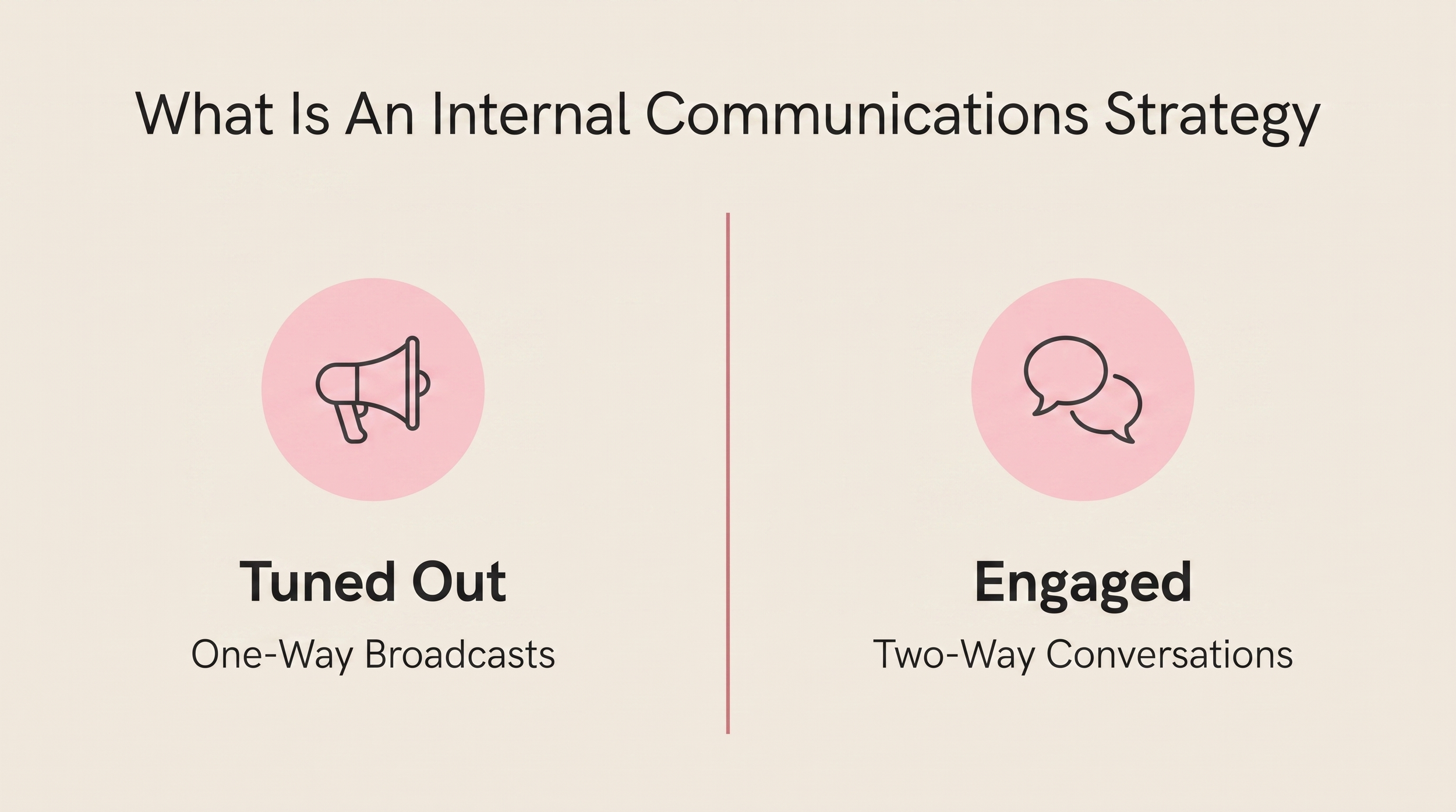
An internal communications strategy is your action plan for how information gets around your organisation – who says what, on which channels, and how often. It is the difference between news reaching the people who need it and a big announcement dying in a Friday-afternoon email nobody ever opens.
The reason so much of it flops comes down to a perception gap. Leaders are convinced they are brilliant communicators, and their people beg to differ. Axios HQ found that 80% of leaders think their comms are clear and engaging, while only 50% of employees agree.
That gap is basically the whole problem. Push information out in one direction, with zero thought for whether anyone actually wants it, and people learn to ignore you fast. A good internal communications strategy example they engage with is built around them, not around your org chart.
And getting it wrong costs real money, not just the odd missed memo. Teams that are out of the loop duplicate each other's work and miss deadlines, and they end up making calls on rumour instead of fact. Every one of those has a genuine price tag on it.
| Employees Tune Out | Employees Engage With |
|---|---|
| One-way broadcasts from the top | Two-way conversations they can join |
| Generic all-staff blasts | Messages relevant to their role |
| Stiff language and stock phrases | Plain, human language |
| Random, unpredictable timing | A steady, reliable rhythm |
| Updates with no reasoning | Context and the why behind it |
| Channels they never chose | Existing channels they already use daily |
What A Strong Internal Communications Strategy Does For Your Company: 4 Key Benefits
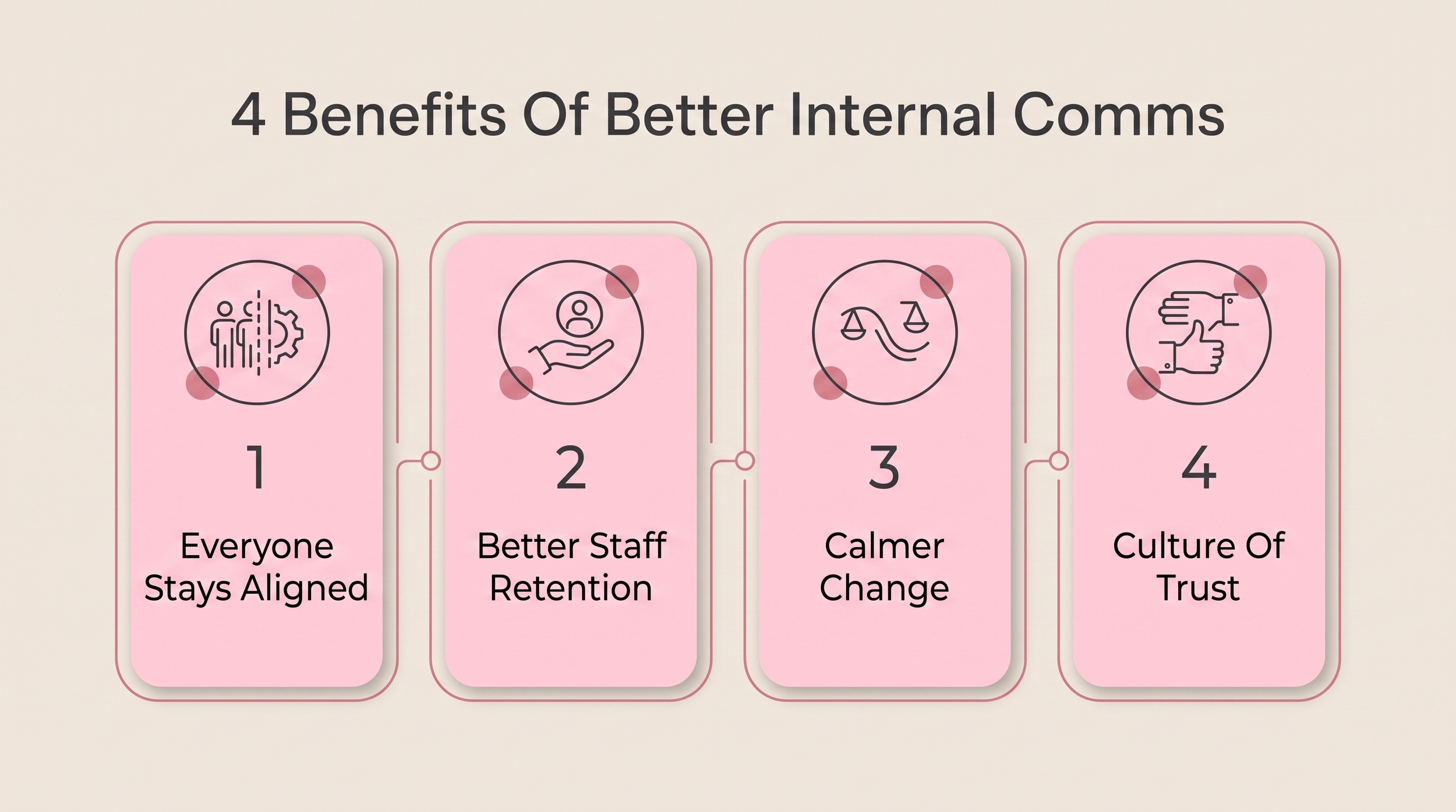
Before we get into the how, let's talk about why an internal communications plan is worth the bother. Four payoffs, and every one of them gets bigger whether you are twenty people or twenty thousand.
1. Everyone Actually Knows What Is Going On
When comms works, nobody is assuming. People know the priorities and the company goals, and exactly what is expected of them this week. So they stop burning energy filling the gaps with rumour. Alignment sounds like a woolly word, but really it is just everyone rowing the same way instead of each pulling their own.
2. Better Engagement, And Fewer People Heading For The Door
Employees stay when they are in the loop and valued, and start eyeing the exit when they feel like the last to know. Communication matters more here than most bosses realise. Staffbase found 63% of people looking to quit said poor internal comms helped push them out. Sorting yours to keep employees informed is one of the cheapest retention tools going.
3. Big Changes Stop Causing A Meltdown
A restructure or a shiny new tool rattles people when it arrives out of nowhere. There is already a technology gap to contend with, with 38% of the workforce saying they can’t keep up with technological changes at work.
Get your comms right and change gets explained early, with the reasoning attached, so people feel brought along rather than ambushed. With a structured plan, the big announcement stops being a bombshell and turns into the obvious next step everyone could already see coming.
4. A Culture Of Trust And Actual Two-Way Feedback
Communication and trust are basically the same muscle. When people can ask awkward questions and genuinely get heard, they start believing leadership is being straight with them. That trust builds slowly and shatters fast. It also gives employees more leadership visibility because senior people have to be present in the conversation.
And it comes far more from what you consistently do than from one beautifully worded announcement. That eventually becomes a key component of your company culture, not just your comms process.
How To Build An Effective Internal Communications Strategy: 8 Easy-to-Follow Steps
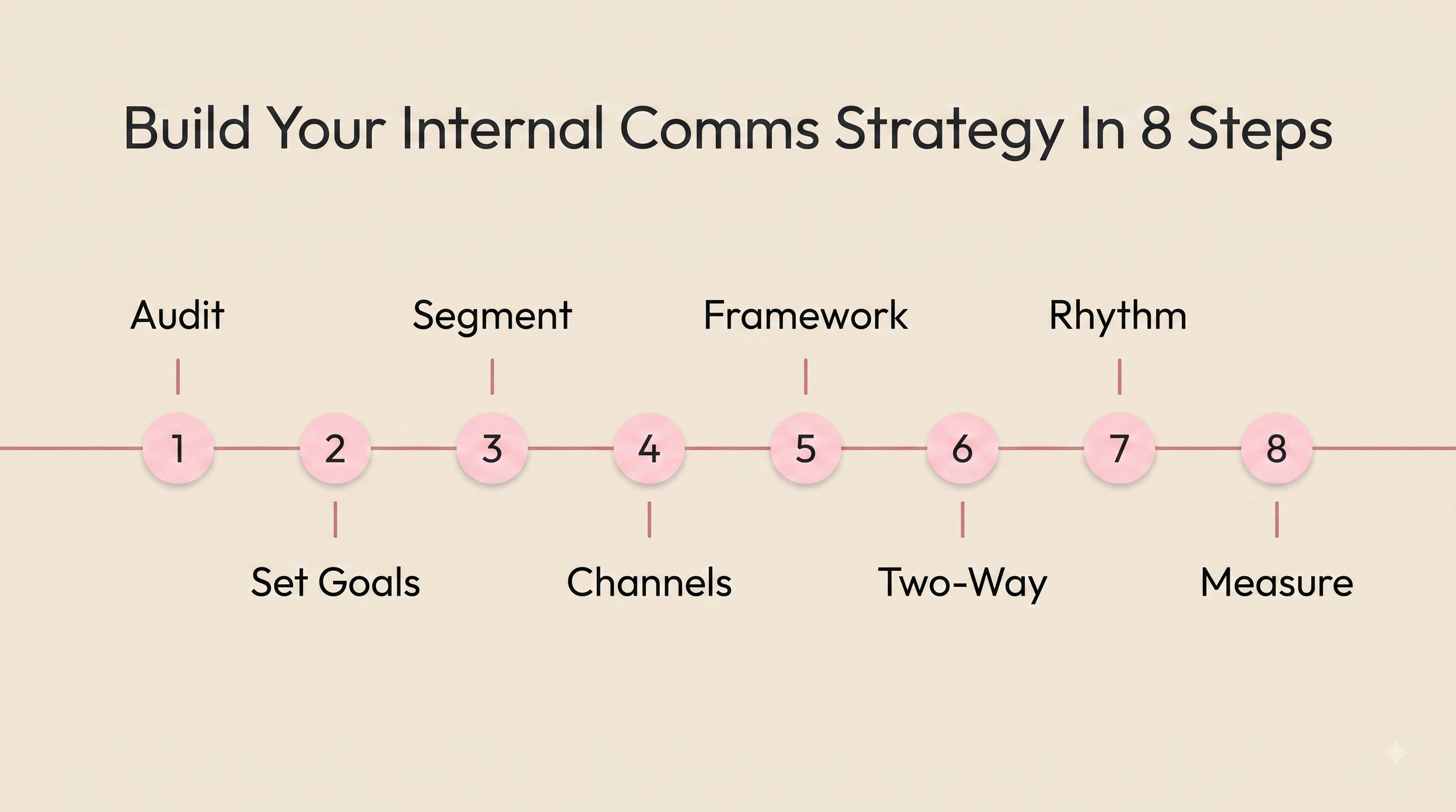
Right, let's actually build the internal communications strategy template. Eight steps, in order, and each one fixes a different leak. Work through them, and you will end up with an internal comms strategy people notice for good reasons.
1. Start With An Honest Audit Of How People Communicate Today
Most places have no real clue how information moves around or where their messages tend to go to die. Skipping this and leaping straight to "let's do a newsletter" is exactly why so many strategies end up solving a problem nobody had. Start by documenting your current communication strategy before deciding what needs changing.
Done properly, an audit nearly always throws up a surprise. The channel the leadership team swears by turns out to be a ghost town, while the real company news travels along a corridor chat nobody ever officially set up. And your internal communications team should be part of this audit rather than assuming it already knows what works.
Map every channel actually in use, official or not, across the whole business
Run a focus group and ask people straight out where they really go for information they trust
Track which recent messages truly got opened and which sank without a trace
Spot where the same update pointlessly gets repeated across five separate places
2. Set Goals Around Behaviour Change, Not Just Opens
An open rate tells you next to nothing. If 90% opened the email and not one person did the thing it asked, the message failed. Real goals are about what shifts, like people adopting the new process or just properly understanding a decision. That is chasing something real, not just views.
Decide the one clear business objective you want from each important message first
Get a baseline number now so you can prove real movement later on
Tie every single communication goal to a business goal key stakeholders already genuinely care about
Bin any vanity metric that looks impressive but shifts nobody's actual behaviour
3. Segment Your Audience So Messages Actually Fit
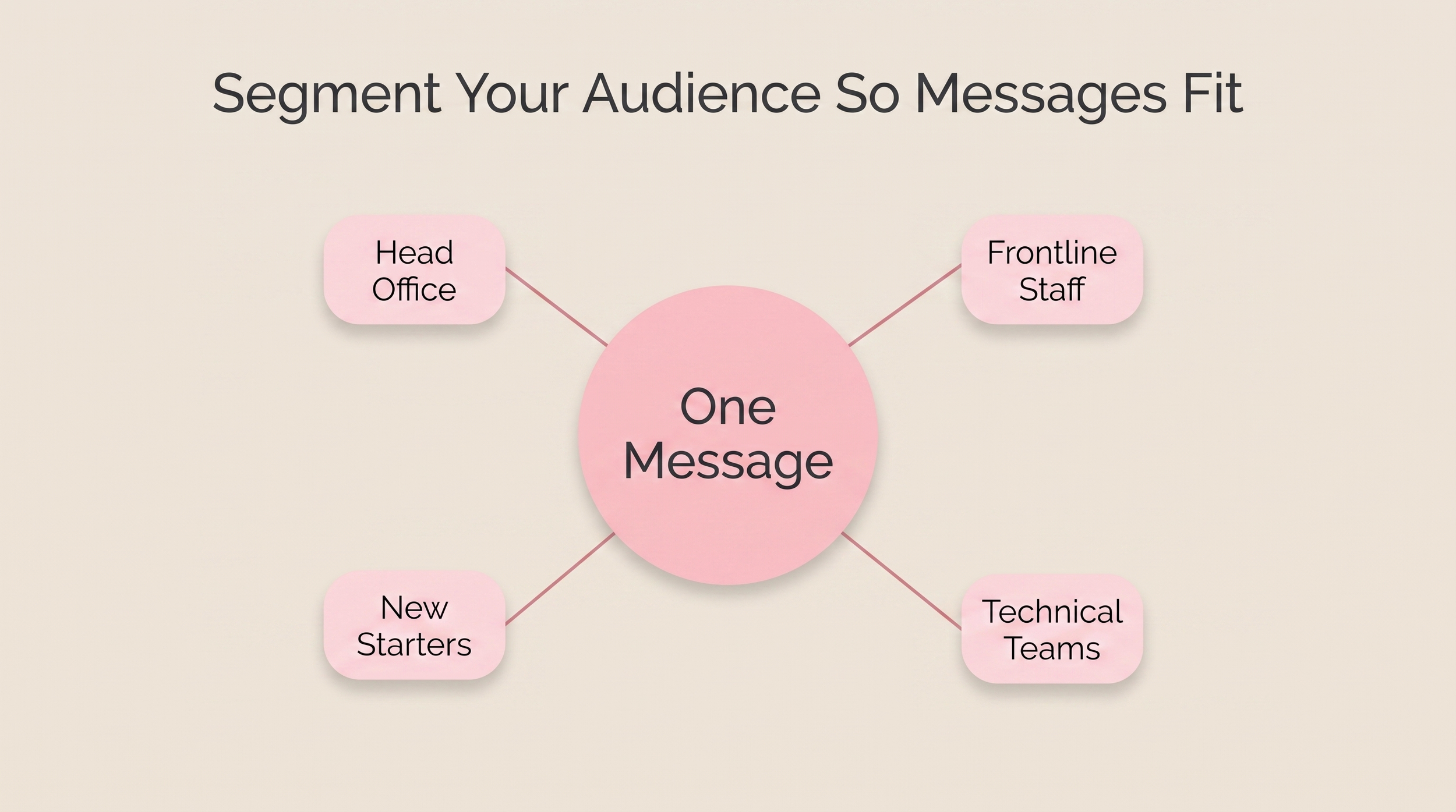
Firing the same message at everyone is the quickest way to get ignored by everyone. Your finance team and your warehouse floor have different communication preferences, in different words, at different moments. And the second a message clearly isn't meant for you, you learn to skim straight past that sender, and then you miss the one that actually mattered.
Group your people by role and location, and by how they work. Factor in employee preferences too, particularly around format and timing
Write each key message in the actual language that group uses daily
Never send your hybrid team a message obviously built for head-office inboxes
Check every group can even receive whatever channel you are planning to use
Segmenting your people matters everywhere, but it turns critical in businesses where the teams barely speak the same language day to day. Picture any company built on deep technical know-how, where a lab or engineering crew works right alongside sales, support, and content people. The same piece of news means four different things to those four groups.
A supplement company like Nootropics Depot's Tongkat Ali collection makes the point nicely. Its products are backed by an in-house lab and UPLC testing, with a certificate of analysis on every batch. When a fresh batch result comes in, that one fact has to reach wildly different employees at once.
The scientists want the raw numbers. The support reps just need a simple line for when a customer asks why the 10% version isn't five times stronger than the 2%. The content team needs something in between for the website. Send all of them the identical message, and you have served none of them.
That is the whole case for doing audience segmentation of your employees, not just your customers. You group people by what they genuinely need to know, then shape the same truth to fit each group. Skip it, and your best knowledge either stays trapped in the lab or reaches the front line so garbled that support ends up assuming.
4. Pick Communication Channels Around How People Already Work
The best channel is the one your people already check. Send a critical update on an intranet nobody logs into, and you have technically communicated while achieving nothing. Every group has a home patch, whether that is a messaging app or a screen on the warehouse wall, and your job is to turn up there.
It is worth remembering the communication platform itself carries a message. The same words look routine on a noticeboard and urgent on the right internal communications tools, so where you send something shapes how seriously people take it.
Match each group to the one channel they check without being nudged
Stop copy-pasting the exact same message across every single channel you own
Give genuinely urgent news a channel that interrupts, not a hidden post
Retire any channel nobody actually uses instead of propping it up forever
5. Build A Message Framework That Puts Relevance First
With no framework, comms turns into a whoever-shouts-loudest free-for-all. And people can't tell the genuinely important from the rest. A simple structure that ranks messages by priority and who needs them keeps the signal clear. Better yet, a repeatable content workflow keeps it that way even as the team grows.
A framework also protects people from each other. Without one, the loudest manager wins the inbox every time, and genuinely urgent news ends up hidden under somebody's non-urgent broadcast.
Create clear tiers, from must-read down to nice-to-know, then label every message
Give every single message a real purpose before it ever goes out
Always include the why and key takeaways behind a decision, not just the what and when
Keep a shared calendar so your big messages never collide or bunch together
6. Make It Two-Way So Employees Can Talk Back
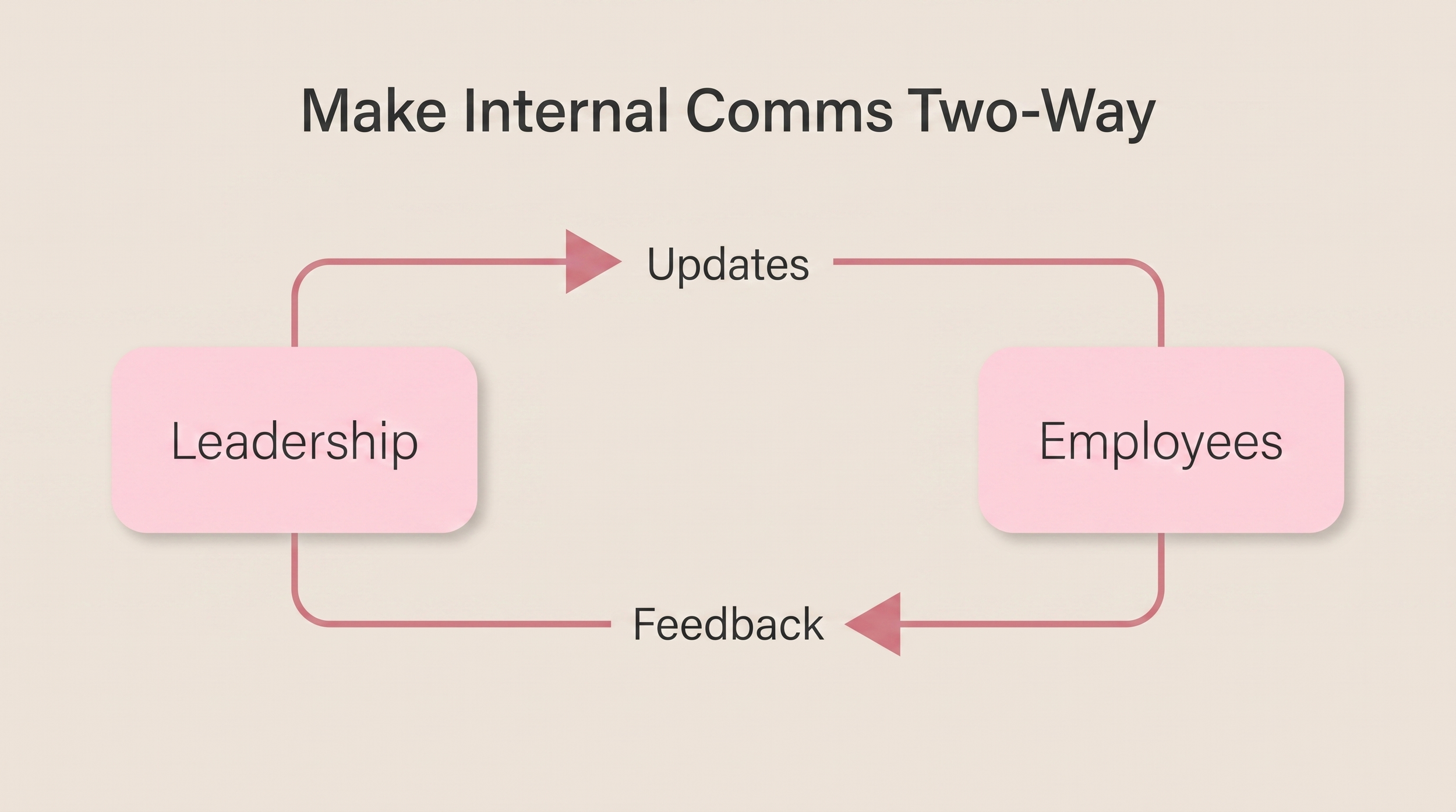
Communication that only ever travels downward isn't really communication – it is a tannoy. People properly engage when they can ask questions and actually be heard, not just sit there receiving.
And the feedback mechanism is gold: your front line spots what is broken long before it shows up on a leadership dashboard. Except most of that insight never travels. A 2025 ScreenCloud study found only 24% of frontline workers feel their feedback ever reaches leadership.
Add a dead-simple way to reply or react to every message sent
Hold regular open sessions where anyone can question the leadership team directly
Route frontline employee feedback straight to the people who can genuinely act on it
Always close the feedback loop by showing what changed because someone spoke up
This bites hardest where the people talking to customers all day sit a long way from the people making decisions. In consumer goods especially, support hears every complaint and every baffled first-time question long before anyone upstairs does. With no internal channel carrying that back up, the same problems keep happening, and everyone downstream keeps paying.
Take something like Brondell’s home water filter systems. Its support team fields the same handful of questions on a loop, from which system suits your tap water to how you would ever know a filter is due. Those aren't just tickets to close. They are the company telling itself what to fix.
Brondell's "filter change indicator" is the tell. That little feature only exists because a support gripe actually reached the people who design the product, and that only happens when the internal comms run both ways.
Where the upward channel is open, one repeated moan from the front line becomes a fix that wipes out a whole category of tickets. Where it is blocked, support just answers the same question forever, and nobody who could change anything ever hears.
7. Lock In A Consistent Cadence And Flow
A patchy communication campaign just trains people to ignore you. Vanish for months, then panic-fire ten updates in a single week, and nobody has a clue what deserves their attention. Strategic communication with a predictable flow does the opposite. A Monday priorities note and a monthly all-hands mean people know when to look, so they actually bother.
Consistency also buys you a bit of patience. Employees stop frantically checking and forwarding everything once they trust the important things always turn up on schedule, which takes pressure off the whole team.
Set a fixed schedule for your recurring updates and then genuinely stick to it
Match the frequency to each group, so nobody feels spammed or forgotten
Protect that comms slot even during your busiest and most chaotic weeks
Keep a steady format so people instantly clock what each update is
8. Measure Real Engagement And Keep Adjusting
A strategy you never measure is really just an assumption you have committed to. The point isn't to sit admiring open rates. It is to set key performance indicators and find out whether people actually understood and acted, then change whatever clearly isn't working.
That keeps the focus on business outcomes rather than message volume. Comms that never get a proper review slowly slip back into the same old broadcasting nobody reads.
Track the action people actually took, not just whether a message opened
Pulse-survey a few teams often on whether the comms genuinely help them. Mix those numbers with qualitative feedback, so you understand why people responded the way they did
Kill or fix whatever the data clearly shows people ignore every time
Sit down and review the entire strategy properly at least twice a year
3 Internal Communications Strategy Mistakes That Kill Employee Engagement + How To Fix Them
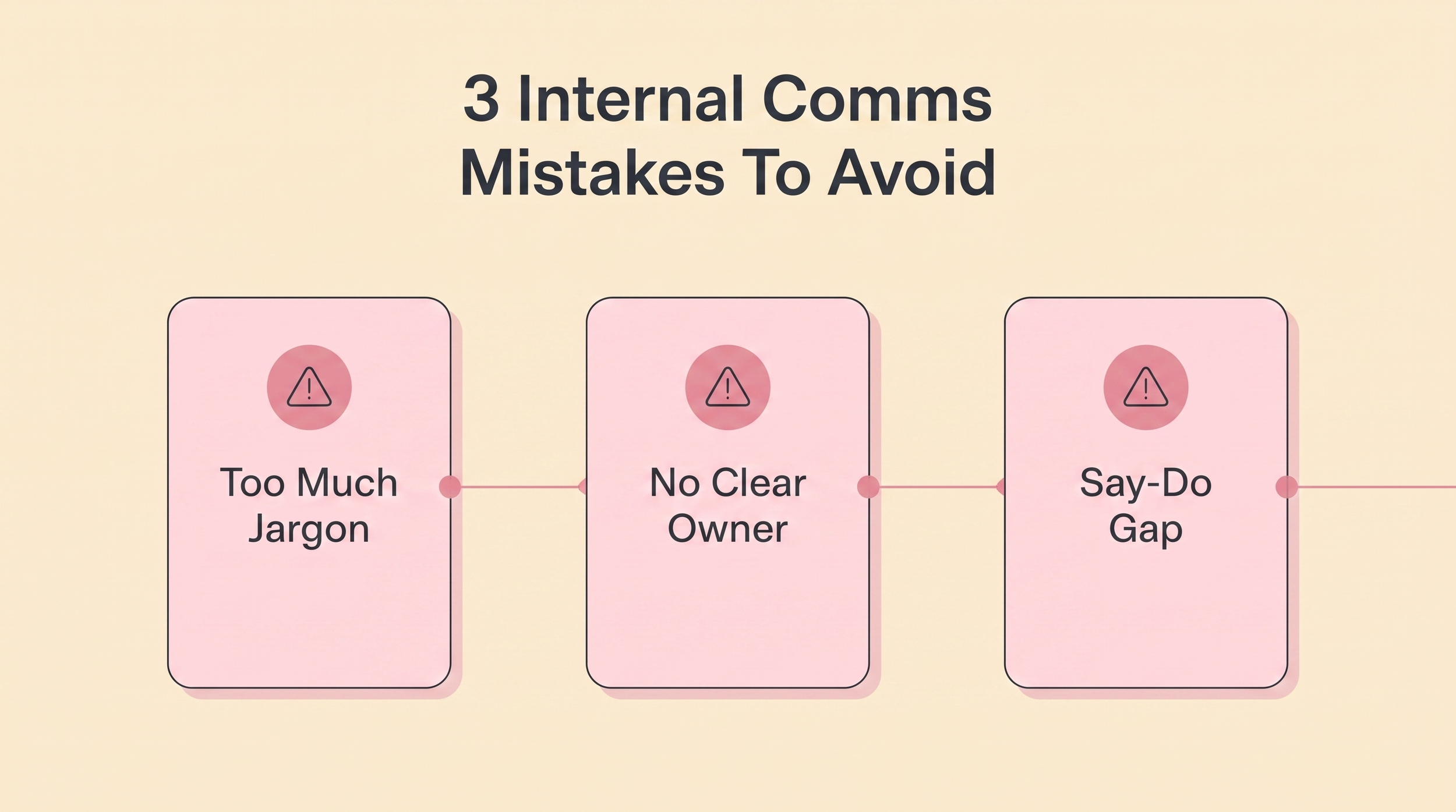
You can get every step above right and still undo it with a few mistakes. These three are the most common ones, and none of them ever feels like a mistake while you are busy making it.
1. Writing In Formal Language That Nobody Uses
"Let's circle back and socialise our north-star deliverables" means absolutely nothing to the person on the loading dock, and honestly not much to anyone else either. Formal language feels safe and senior, but it tells the reader this message isn't really for them, so they switch off. The more inside-baseball your language, the fewer people you actually reach.
Food and drink is a brilliant place to see this in action. Kitchens run on insider language, the exact cuts and odd offal names, and most of it means nothing to a brand-new commis chef or a customer squinting at the menu.
When the prep sheets and training notes are stuffed with unexplained terms, new starters mis-prep and servers freeze on simple questions, and good food and money get binned.
The fix is writing that assumes nothing. This simple guide to the types of tripe is a lovely example. It explains honeycomb and blanket tripe in language a total beginner gets straight away. And that is the clever part: it is written so simply that it serves a curious customer and a nervous new cook at exactly the same time.
That is the bar your internal comms should clear. Write every update so the newest and least-clued-up person gets it first time, and it will still serve everyone above them. Inside your own walls, every acronym and code-name is obvious to you and a locked door to half the building. And locked doors are ones people stop bothering to open.
How to Fix: Write like you are explaining it to a sharp mate outside your team. Ditch the acronyms or spell them out once, and cut the clichés. Then read it back aloud, and if it sounds like a press release, write it again like a human.
2. Leaving Internal Comms Without A Clear Owner
When internal comms is everybody's job, it is nobody's. Messages go out with no coordination, and there is no one on the hook when something important is missed. It becomes the thing that gets squeezed in around "real" work, which is precisely why it stays forgettable year after year.
How to Fix: Hand internal comms to one clear owner, even if it is only a slice of a bigger role. Somebody has to hold the communication calendar and guard the standards, and be the person willing to say no to yet another pointless all-staff email.
3. Leaders Whose Actions Contradict The Message
Nothing torches engagement faster than a leadership team that says one thing and does another. Preach transparency, then make all the big calls behind closed doors, and every future message gets read with a raised eyebrow. People believe what they see far more than what they are told, so a say-do gap slowly poisons the entire channel.
How to Fix: Get your senior leaders treating their own behaviour as communication because it already is. Before a message goes out, check it actually matches what leadership is doing. If it doesn't, fix the behaviour first, not just the wording.
Conclusion
Engagement never comes from sending more. It comes from sending less but better, and listening to what comes back. Pick the two or three steps where you are weakest, fix those first, and let people feel the difference. An internal communication strategy that engages employees respects their time and their voice.
This is the thread we are forever pulling at over at Sophisticated Cloud. We design digital experiences people genuinely want to engage with, built on clear thinking and good design rather than templates and distractions. Whether it is your customers or your own team, clarity and good design earn attention. If that is the bar you are after, start a conversation with us.

Author Bio:
Burkhard Berger is the founder of Novum™. He helps innovative B2B companies implement modern SEO strategies to scale their organic traffic to 1,000,000+ visitors per month.
Curious about what your true traffic potential is?
Gravatar: vip@novumhq.com