How Cloud Communication Enhances Modern Web Designing

Digital presence now dictates brand identity, forcing web tools to evolve rapidly. Mirroring the banking sector's shift toward AI, web development is undergoing a massive, cloud-powered transformation to increase efficiency, precision, and overall global project accessibility.
Days when designers lived in their own world are long gone. The cloud enables real-time collaboration and instant scalability in 2026, setting a new gold standard for the operation of modern digital projects in a world of high interconnectivity.
Cloud communication is no longer a mere utility; it is the driver of innovation. It promotes connectivity by enabling seamless next-generation immersive, high-performance web experiences that characterize how we engage with the contemporary digital world.
What is Cloud Communication in Web Design?
Cloud communication refers to integrating internet-based platforms—ranging from storage and design tools to unified communication systems—into the creative workflow. For a web designer, this means your entire "office" exists wherever you have an internet connection.
It would be the cloud that allows its syncing of high-resolution assets (around an international team) or the ability to use a VoIP service provider to liaise with its clients (in other time zones), etc. The cloud would eliminate the physical barriers that previously slowed down the creative process.
The 2026 Shift: Why Modern Web Design Requires Cloud Innovation
As we approach 2026, web complexity is reaching new heights. We are shifting toward "agentic web experiences" that adapt in real-time. This requires a connected cloud stack where tools communicate seamlessly to manage these intelligent, evolving systems.
Cloud infrastructure enables this massive transformation by providing the necessary power for instant data processing. Every component, from code to management, must remain unified within the cloud to deliver the speed and precision that brands demand. Let’s learn more:
1. The Emergence of " Agentic " and Adaptive Layouts.
By 2026, websites will be predictive and not responsive. The AI in the cloud will automatically scan visitor information to modify layouts and typography, and will produce hyper-personalized journeys that have never been achieved before, given the processing capacity of current cloud systems.
Such a high degree of customization is entirely based on the cloud-first architecture, which performs complex computations when the page loads. This means that designers can now create interfaces that think, and every user is guaranteed a unique, optimized, and highly engaging digital experience.
2. Sustainability and Builds-First Performance
Modern developers are now primarily concerned with environmental impact. Cloud-first design encourages low-carbon architecture by using edge computing, which is done closer to users. This type of strategy significantly reduces server load whilst delivering truly astronomical performance.
These lean systems ensure that even the most visually demanding websites load in seconds. With sustainability as a key factor in cloud optimization, the future of web design is to balance the high-speed digital experiences with a significantly reduced carbon footprint.
Why Every Design Agency Needs a VoIP Service Provider
The formula of the successful web design projects is communication. When a designer, developer, and client are perfectly aligned, projects are developed more quickly and with fewer revisions. In this case, a VoIP service provider proves a significant component of the design toolkit.
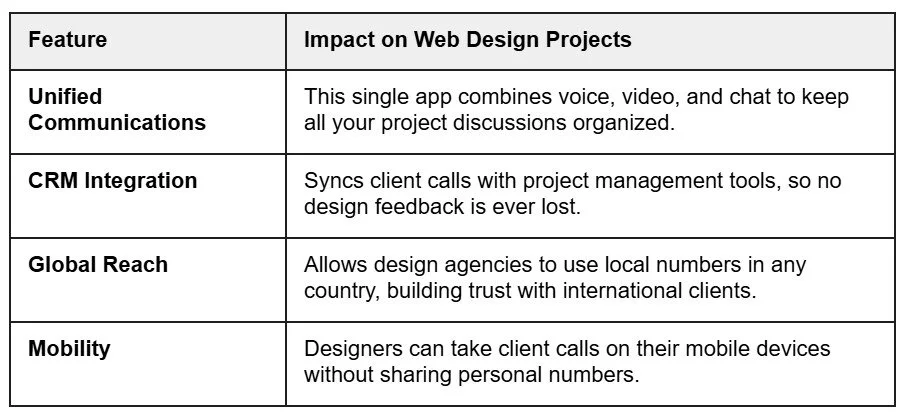
Using professional VoIP phone services helps designers get feedback faster. High-quality video and screen sharing allow for instant reviews, turning slow email chains into quick, live workshops where teams can collaborate and finish their creative projects much sooner.
Top Use Cases: Cloud Communication in Action
Cloud communication is performed in the background, like AI agents in banking, to keep everything running smoothly.
1. Real-Time Co-Editing
Tools such as Figma and Canva have introduced the concept of multiplayer design. This is also applicable to the code itself by 2026. By using cloud-native IDEs, code written by two or more developers can be run and tested in a single file, eliminating the nightmare of version control.
2. Centralized Asset Management
Forget managing endless file versions on local drives. Modern cloud storage creates a unified workspace where every creator sees the same data. This shared access eliminates confusion, keeps designs accurate, and allows teams to collaborate instantly.
3. Automated Testing and Deployment
Modern CI/CD pipelines let designers upload updates to staging areas for automated evaluation. These cloud tools scan for accessibility, SEO, and responsiveness, ensuring every site is perfectly optimized and error-free before it officially launches for users.
Advantages of moving to Cloud-Native Workflows
The banks and other financial institutions are constantly under pressure to perform more quickly and minimize risk; the same is true of web design agencies. Here are the core benefits:
Rapid Iteration: Real-time cloud feedback loops significantly accelerate the approval process.
Lower Overheads: Affordable subscriptions replace the expensive on-site hardware and server maintenance.
Instant Scalability: Systems expand effortlessly to handle massive traffic spikes or launches.
Elite Protection: Providers supply advanced encryption and security that individual agencies cannot replicate.
How Businesses Can Start Leveraging These Tools
To begin, identify your currently siloed workflows. Move communication to a unified platform and shift all design assets to a collaborative cloud environment. This creates a solid foundation for more efficient, modern team coordination and growth.
Then collaborate with technology professionals to seamlessly integrate these systems. The same goes whether you are a freelancer or a big agency; switching to the cloud has become a crucial survival tool, not a mere luxury.
This is the change that you should embrace to be ready to operate in the future of web design in 2026. Centralizing actions helps you keep your business afloat and position you to offer high-quality, high-speed digital experiences to clients, which they demand.
Challenges and Considerations
Although the advantages are enormous, the following barriers should be known to the companies:
Data Protection: End-to-end encryption of client assets and sensitive code should be implemented.
Legacy Connections: Existing design workflows may not be easily connected to cloud agents, and transitioning to them may require careful planning.
Initial Investment: High-end cloud systems and a VoIP service provider can be costly to implement, especially for setup and training.
Conclusion
Financial AI agents have transformed the banking industry, making it faster and safer; cloud communication is also transforming the web design business. With the advent of new tools and the emphasis on collaborative, cloud-based workflows, designers can create digital experiences that are more innovative, efficient, and beautiful.